Sep 20, 2026Material Science
Beyond the "Naked-Feel": An Insider's Guide to Sourcing Premium Yoga & Pilates Fabrics
A practical guide from Guangzhou on sourcing yoga fabrics: 75/25 nylon-spandex blends, GSM weights, daylight testing, and pattern cuts that prevent the dreaded T-line.
The problem with swatch cards
Every week, I watch brand founders fall into the exact same trap. A courier drops off a stack of swatch cards, everyone sits around a desk petting tiny four-inch squares of fabric, and someone inevitably says: "This one feels amazing. It has that naked feel."
I understand the impulse. We all want pieces that feel like butter when a customer picks them up off a rack or pulls them out of an unboxing pouch. But a swatch sitting flat on cardboard tells you almost nothing about how a pair of leggings will behave during an hour-long reformer pilates session.
I spend my working days here in Guangzhou cutting rolls, pulling panels across my knees, and checking dye lots. If there is one thing I have learned running Miss K, it is that a fabric can feel heavenly on your fingertips and still turn into an utter disaster the moment someone bends over in direct sunlight.
When you source activewear fabrics for a premium line, you have to look past the initial touch. You have to look at what happens when the knit is stretched to its absolute limit, held there under tension, and washed twenty times.
The anatomy of 75/25
In our hero range, the core fabric is almost always a nylon and spandex blend, roughly 75% nylon and 25% spandex.
There are plenty of polyester blends on the market, and they have their place in lower-tier activewear or technical running gear where sweat-dumping is the only metric that matters. But for yoga, pilates, and studio movement, polyester usually feels slippery and plastic. It traps body heat in an uncomfortable way, and over time, it hangs onto locker-room odors.
Nylon gives you that cool, soft hand feel. It drapes naturally, takes color beautifully, and brushes gently against the skin without feeling synthetic.
Spandex, the other 25%, does the real physical work. People often think adding more spandex just makes a garment stretchier. Actually, high-grade spandex provides recovery. Anyone can make a knit that stretches wide. The difficult part is making a knit that snaps back instantly to its original shape without bagging at the knees or slumping around the lower back after two hours of wear. When a fabric lacks recovery, the customer puts the leggings on in the morning and by afternoon the ankles are sagging.
If you drop the spandex ratio down to 10% or 15%, you might save on your raw material costs, but the garment will lose its hold. In our studio pieces, that 75/25 balance is where the sweet spot lives.
Finding the right weight: 200 to 260 GSM
Fabric weight is measured in grams per square meter (GSM), and this single number dictates how a garment hangs, breathes, and supports. In our Miss K hero range, our sampling weights generally run between 200 and 260 GSM.
Choosing where you fall on that spectrum comes down to the garment's purpose:
• 200 to 220 GSM: This is our lighter weight. It is ideal for camisoles, light bra layers, and flowy studio tops. It breathes well, layers cleanly under a sweatshirt, and feels weightless on the body. If you use it for bottoms, however, you run a serious risk of sheer spots.
• 240 to 260 GSM: This is where we sit for compressive leggings, flared pants, and high-support pieces. That extra density creates smoothing compression, holds clean lines, and gives the wearer a feeling of coverage and security without feeling stiff like denim.
I often have clients ask for an ultra-lightweight 190 GSM legging that provides deep compression and complete opacity. I have to tell them gently that physics does not work that way. If you want a pant that smooths the hips and hides an undergarment line, you need the density of a 240 to 260 GSM knit.
Color plays a role here, too. Our standard Miss K palette runs across five core shades: Black, Espresso, Cream, Sage, and Blue Grey. Black and Espresso naturally absorb light, so you can sometimes run them slightly lighter without trouble. But light tones like Cream and Sage require a very disciplined yarn structure and careful GSM calibration, or they will show through under bright studio lighting.
Two tests you can do without a lab
You do not need a textile lab to screen your production samples. When samples arrive on your desk, you can run two quick checks in your own office.
The first is the stretch-and-recovery pull. Take a leg panel between both hands, spaced about four inches apart. Pull your hands apart as hard as you can, stretching the fabric to roughly double its width. Hold it there for five seconds, then let go immediately.
Watch how it returns. Does it snap back to its flat state instantly? Or does it linger, leaving a warped, wavy section in the knit? If it ripples or takes several seconds to smooth out, that yarn will stretch out permanently after a few workouts.
The second test is the daylight squat test. Turn off the cozy indoor lamps and walk directly over to a window with natural daylight. Have someone put the sample on and drop into a full, deep squat with their back to the window. Stand right behind them at floor level.
Fluorescent office lighting hides flaws. Bright, natural outdoor light exposes everything. You will see immediately whether that 220 GSM knit in Cream or Sage holds its density across the glutes or turns translucent under tension. If you see undergarment edges or skin tones, the yarn density is too loose.
Construction fixes what fabric cannot
Even the best nylon-spandex blend will fail if your pattern cutting is thoughtless. Fabric and construction have to solve problems together.
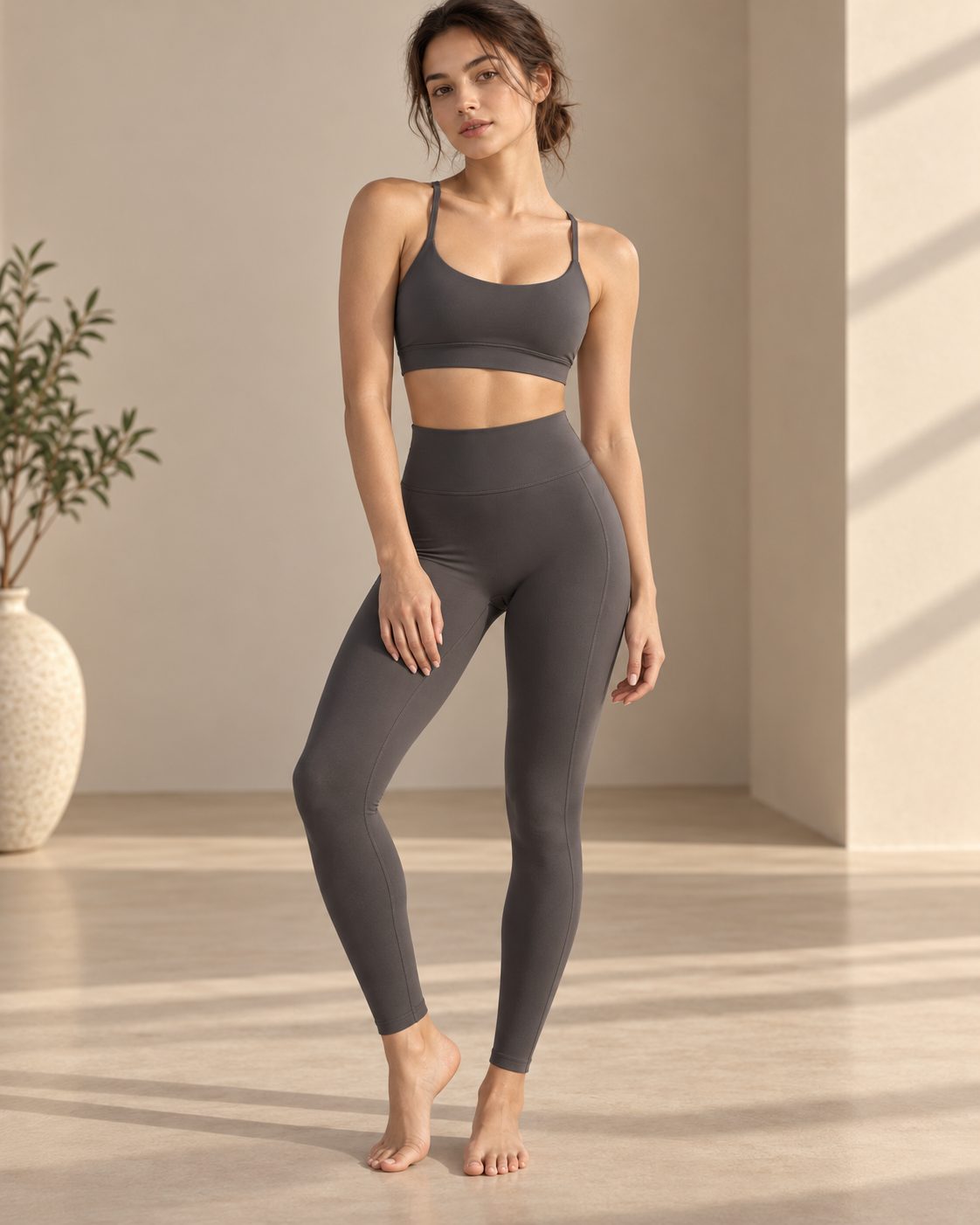
Take the infamous "T-line" seam at the crotch. In traditional activewear patterns, a vertical front seam runs straight down through the rise and meets a horizontal cross seam. When a client pulls those leggings high onto the waist, that vertical seam draws inward, creating the visible camel-toe effect that customers constantly complain about online.
We build our hero leggings with a no-front-seam construction. Eliminating that center front seam creates a completely clean, flat front panel. It eliminates friction against sensitive skin, stops chafing during long walks, and permanently removes the T-line issue without needing awkward, bulky padding.
The same attention goes into the waistband. A high-rise waistband should stay flat against the stomach without needing an elastic cord that cuts into the waist. We construct them wide, using the natural recovery of the 240-260 GSM fabric to hold the waist securely in place.
For tops and camis, good design means building in an internal shelf bra with soft, removable cups. The cups give shape and modest coverage, but they must be easy to remove for washing. The under-bust band on that shelf bra needs to be soft-edged so it anchors the bust line without leaving red marks on the ribs at the end of the day.
Working together from Guangzhou
We run Miss K from Guangzhou, right in the center of the world's most capable textile and apparel manufacturing hub. From here, we ship worldwide to independent brand owners who want their activewear to match the finish of established luxury labels.
We run two distinct models for our clients:
If you want to move quickly, we offer a private label program based on our developed hero range, eight refined styles for 2026, dialed in across our standard colors (Black, Espresso, Cream, Sage, and Blue Grey). You apply your custom branding, woven labels, and packaging to styles that have already been pattern-tested and fit-corrected.
If you have your own design sketches, unique tech packs, or specific measurements, we run full OEM and ODM custom development from the ground up. We source specialized knits, cut custom paper patterns, and run physical fit samples until the silhouette matches your vision.
Good activewear is not about industry buzzwords. It comes down to honest materials, strict GSM targets, and clean pattern work that respects how real bodies move.
If you are planning your next studio collection, take a look at our products page to see our hero silhouettes, or email me directly at info@misskyoga.com. If you prefer to talk through sample details in real time, you can also reach our desk on WhatsApp at +86 136 4085 9182. Send over your target weights or sketches, and let's get some physical swatches into your hands.
Related styles: No-Front-Seam Leggings · Elite Milani-Soft Pocket Flare Pant · Foldover Flare Pants.