Sep 23, 2026Fit & Silhouette Engineering
Waistband Styles Compared: Crossover, Foldover, Banded
Crossover, foldover, banded and contour waistbands compared - how each is constructed, what it does for fit and comfort, and which styles each one belongs on.
Ask a customer why she returned leggings and the answer is rarely the fabric - it is the waistband. Rolling down in a forward fold. Digging in at the hips. Gapping at the lower back when she sits. The waistband is the single most fit-sensitive component in bottoms, and it is also the component buyers spec least precisely.
"High-waist" is not a spec. A waistband style is - and each of the four main constructions behaves differently in production and on the body. Here they are, compared honestly.
Banded Waistbands: The Reliable Default
The banded waistband is the workhorse: a band of self-fabric or covered elastic sewn around the top edge, usually 3-7 cm high, sometimes with internal elastic for extra hold. It is what most compression leggings and training shorts use.
Strengths: predictable production, strong hold, excellent recovery when paired with a dense knit - the 240-260 gsm compression family handles it well, as covered in the fabric guide, nylon, spandex and gsm explained.
Watch-outs: an exposed or over-tight elastic digs into the stomach when the wearer bends. The fix is construction, not luck - a wide band, elastic wrapped in fabric, and the elastic tension matched to the garment's compression level. Cheap leggings dig because the elastic is cheap and narrow, not because elastic is wrong.
Best for: compression leggings, biker shorts, training shorts - anything where hold matters more than a decorative waistline.
Foldover Waistbands: Two Looks in One Garment
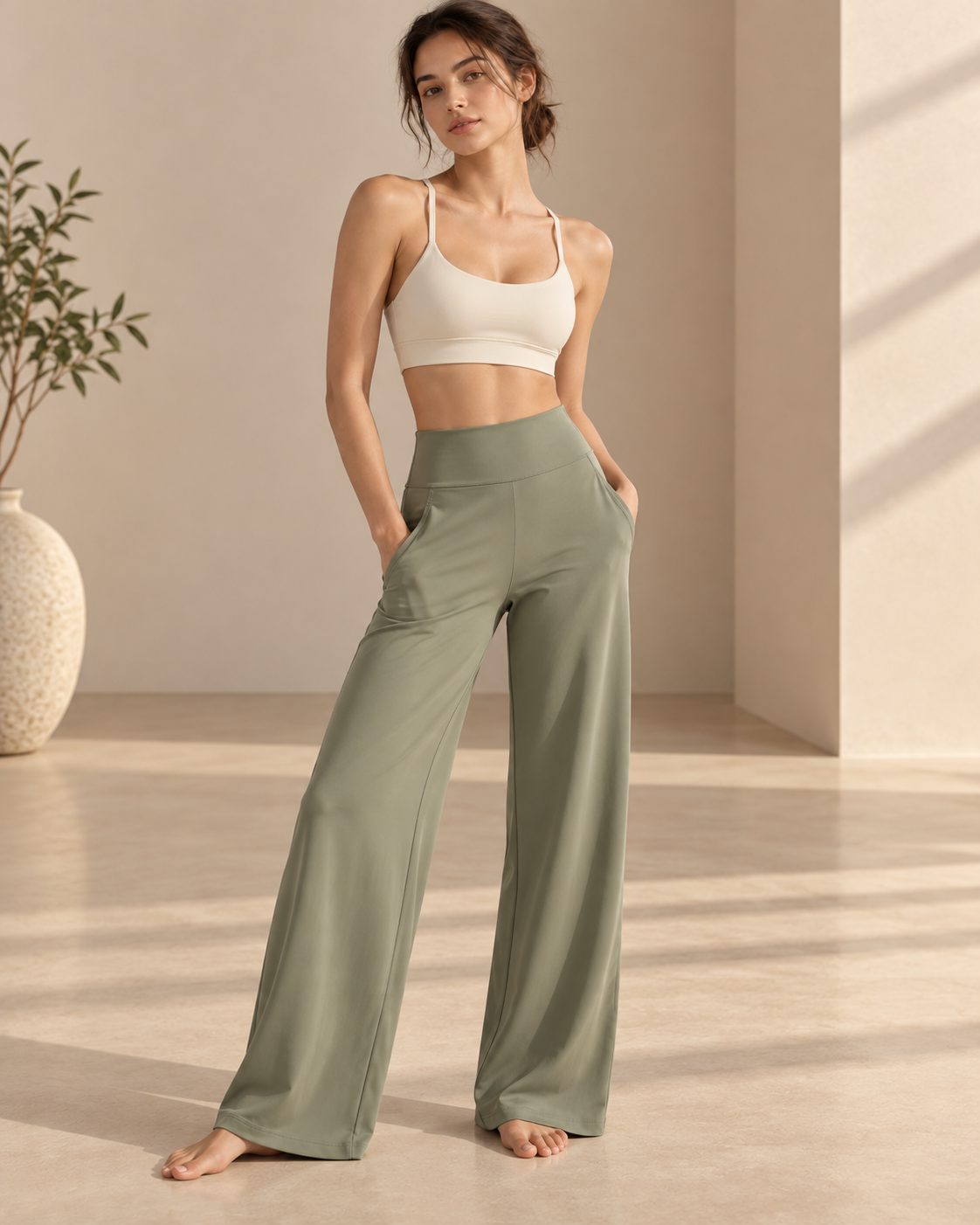
A foldover waistband is extra-tall self-fabric (typically 15-25 cm unfinished) that the wearer can fold over - high cover when up, a relaxed rolled look when folded down. It has become the signature of the studio-to-street trend and pairs naturally with flared silhouettes; our own foldover flare reference style is built exactly this way.
Strengths: adjustable rise on the body, no elastic to dig, soft feel, and a distinctive look that photographs well.
Watch-outs: bulk at the fold if the fabric is heavy or the seam allowance is thick; the doubled fabric needs clean finishing or the fold shows a ridge. It also offers less grip than banded elastic - on very stretchy or slippery fabrics, a foldover band can slide during vigorous movement. The honest spec: foldover for yoga, pilates and lifestyle; banded for running and training.
Best for: flare pants, wide-leg pants, relaxed studio styles and any piece where the wearer will actually use the two-way rise.
Crossover Waistbands: The Contour Statement
The crossover (or V-front) waistband wraps the hips with two overlapping panels that meet in a V at the front. It shapes the waistline visually and distributes pressure along an angle instead of a straight band, which many wearers find gentler on the stomach.
Strengths: flattering lines, smooth front, and a distinctive design signature that separates a style from generic leggings - the sculpt legging in our reference range uses a crossover-adjacent waist treatment for exactly this reason.
Watch-outs: pattern complexity. The overlap must be engineered so the panels do not gape open when the wearer squats or sits - that takes a pattern maker who understands stretch behavior, and a sample round to prove it. Cost per garment is slightly higher, and the construction punishes cheap execution visibly.
Best for: sculpt leggings, lifestyle leggings, and any style whose selling point is waistline shape.
Contour and Back-Yoke Variations
Between those three main families sit the contour variants: curved top edges that sit higher at the back than the front (solving the lower-back gap when sitting), and back-yoke bands that add shaping over the glutes. These are pattern-level refinements rather than separate categories - worth requesting when your fit feedback mentions sitting gaps or back coverage, and they combine happily with any of the three main styles.
How to Choose - and How to Spec
Map the waistband to the garment's job:
• Maximum hold, minimal fuss: banded, 4-6 cm, elastic wrapped in self-fabric.
• Two-way styling, soft feel: foldover, 15-25 cm, clean interior finishing.
• Waistline shaping as a selling point: crossover, engineered panels, proven by a fit model in a deep squat.
And spec it like a component, because it is one: band height, fabric (same as body or different), elastic (yes/no, width, tension), finishing method. Vague waistband specs are the number-one cause of the fit revisions described in the sampling guide, how to give sample feedback suppliers can act on.
Then judge the sample the way the customer will: forward fold, sit, squat, and a full day of wear. A waistband that passes those four is a waistband you can ship - the same test-first discipline used for opacity in the sheer-leggings guide.
Common Questions
Which waistband is best for tummy control?
A firm banded waistband with wrapped elastic, wide enough to distribute pressure, gives the most reliable control. Crossover adds shaping visually; foldover offers the least active control.
Why does my waistband roll down?
Three usual causes: the band is too narrow for the body fabric's compression, the elastic tension is too low, or the fabric's recovery is poor so the band stretches out during wear. Each has a different fix - width, elastic spec, or fabric - which is why diagnosis matters before reordering.
Are foldover waistbands suitable for sports?
For yoga, pilates and lifestyle, yes. For running and high-impact training, no - the fold can shift and lacks the anchor of elastic. Match the band to the intensity.
Do crossover waistbands cost more to produce?
Slightly - more pattern engineering and an extra panel seam. The premium is small at bulk quantities, and it buys a visible design differentiator.
One Component, Four Personalities
Waistband choice is where fit, comfort and design language meet - and it is fully within your control as a buyer. Name the style, spec the details, test the four movements, and the most common return reason in activewear quietly disappears from your reviews.
Waistband construction is one of the fit details we tune on every bottoms style we coordinate at Miss K - sampling in 5-7 days gets you a real waistband to judge, not a sketch. Bring your fit notes to info@misskyoga.com or WhatsApp +86 136 4085 9182, and we will match the band to the style and the customer.