Sep 20, 2026News & Insights
How to Build Your First Activewear Collection
A practical framework for your first yoga or activewear collection: which styles to launch, how to build a palette that mixes, what details drive returns, and how to plan a first order.
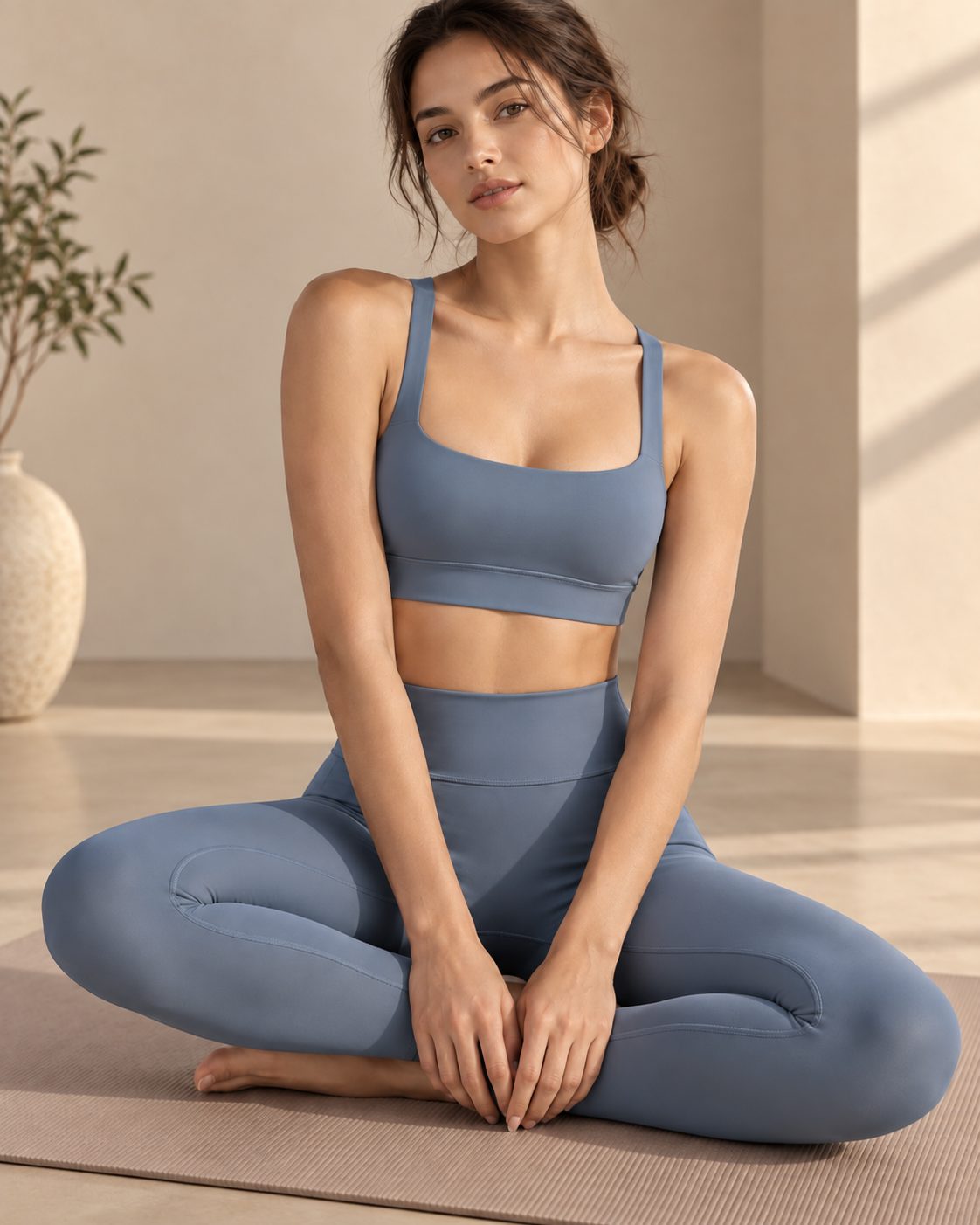
Every founder I work with wants their first collection to look like the brands they admire - twelve styles, eight colorways, a jacket, a onesie, the works. And every buyer I know who has done this more than once will tell you the same thing: your first collection should be small, boringly coherent, and built to learn.
I coordinate yoga and activewear production in Guangzhou, which means I watch what happens after launch, not just at it. The collections that survive are not the biggest ones. They are the ones designed so every piece works with every other piece, ordered in quantities the brand could afford to be wrong about.
Here is the framework, step by step.
Start With Eight Styles, Not Forty
Eight is not a magic number - it is a discipline. In practice, a first range needs four anchor styles and four supporting styles. The anchors are what almost every customer buys first: a legging that stays opaque and stays up, a bra or top that works as a set-builder, a pair of shorts, and one studio-to-street piece. The supporters round out the line without doubling your inventory risk.
Our own reference range follows this logic - eight styles total, which I walk through in the launch-planning guide on starting a yoga wear brand with a sensible first order. The reason to stay small is not minimalism. It is that every extra style multiplies your sampling cost, your size curve, your photo budget, and the amount of cash trapped in your worst seller.
Choose Silhouettes That Work Together
A collection is a conversation between silhouettes. If every bottom is a different rise and every top a different length, nothing pairs and your customer has to think. Design so that any top works with any bottom:
• Keep rises consistent - if your leggings are high-rise, your shorts and flare pants should sit at the same natural waist line.
• Match compression families. A squishy relaxed top over a 260 gsm compression legging reads as two different brands. Pick a fabric family and stay inside it.
• Include one silhouette with room in it - a wide-leg pant, a foldover flare, a relaxed tee. Collections that are all compression exhaust people. The current appetite for wider legs is covered in my piece on the flare pant revival and choosing silhouettes by body type.
• If your audience includes pilates students - and for most city brands it does - make sure at least one top and one bottom are comfortable lying flat on a carriage. The construction differences are real; I covered them in what pilates demands from yoga wear.
Build a Palette of Five Colors
Five colors is the sweet spot: enough to look like a collection, few enough to produce without exploding your MOQ. Black, espresso, cream, sage and a blue grey have stayed in our core palette because they pass three tests: they photograph consistently, they flatter a wide range of skin tones, and any top in any of the five works with any bottom in any of the five.
That mix-and-match rule is what turns a palette into sales. Sets outperform singles in conversion, and a tight palette is what makes sets possible without a dozen dedicated set SKUs. The merchandising logic is in my guide on building a matching set collection that sells.
One warning from the dye floor: consistency across a palette is a production discipline, not a given. Light shades are unforgiving, and blacks drift between dye lots. If color consistency matters to your brand - and it should - read about the production habits that keep a collection color-true in why black leggings do not always match black bras.
Design for the Details That Cause Returns
Customers do not return leggings because the color was slightly off. They return them because a seam dug in, a waistband rolled, or the fabric went sheer in daylight. Get these four details right at design stage:
• Front seams: a no-front-seam construction removes the friction point that generates most complaints about leggings. It is a pattern choice, not a fabric upgrade.
• Waistbands: wide, double-layer, no exposed elastic cords. It should stay put in a forward fold and stay flat when you lie down.
• Stitching density: the interior quality nobody photographs is the quality customers feel. Micro-dense stitching in a sports bra is the difference between a top that survives a season and one that pills by month two - I explained why in why stitch density matters in a sports bra.
• Construction logic: seams placed away from pressure points, gussets that let the garment move, finishes that survive the wash. The full engineering walk-through is in my step-by-step piece on how performance pants are engineered.
Plan the Size Curve Honestly
A first collection usually ships in four to five sizes. Two rules keep the curve honest. First, fit-test on the smallest size, the middle size and the largest - grading a pattern is not scaling a photo, and problems appear at the extremes first. Second, publish real measurements, not aspirations. Returns from size confusion are a self-inflicted wound, and honest size charts cost nothing.
Ask your production partner how each style grades across the curve. A style that fits beautifully in S but disappears in XL is a style that will generate exactly the reviews you do not want.
Budget the Development, Not Just the Order
Founders budget production and forget development. Before a single bulk piece is sewn, your real first-collection budget includes: samples for every style (and the revision rounds), swatch and fabric costs, labeling and packaging development, photography on real bodies, and a buffer for the one style that needs a second sample round. That buffer is not optional - planning for a re-sample is what separates a calm launch from a crisis.
Private label minimizes this layer because the patterns are proven. Semi-custom adds modification cost. Full custom adds pattern engineering - worth it for hero pieces, wasteful for basics. Match the route to each style's job, which is the core argument of the private label versus ODM versus OEM breakdown.
Plan the First Order Around Learning
Your first order's job is not profit. Its job is to convert uncertainty into data at the lowest reasonable cost: which styles sell, in which colors, in which sizes. Order depth on your safest bets, breadth across the palette, and resist the temptation to correct for every possible outcome - that road leads to a storage unit full of sage green.
MOQ in yoga wear typically runs 800-1,000 pieces per color. Split smartly: fewer colors per style, more styles in the range, and you keep the same minimum while learning ten times as much. The full arithmetic is in my MOQ planning guide, what MOQ means and how to plan around it.
Common Questions
How many pieces should a first activewear collection include?
Six to ten styles is the practical range. Below six, the shop looks empty; above ten, a small brand cannot sample and photograph everything properly.
Should I launch with sets or separates?
Design separates that pair into sets. Dedicated set SKUs double your inventory risk; a tight palette gives you set sales without set stock.
How long does a first collection take to produce?
With private label: about 5-7 days for samples and 15-25 days for bulk after approval, plus shipping. Full custom development adds weeks of pattern work before sampling even starts.
When should I expand the collection?
When two or three styles have proven sell-through and restock. Expansion should be led by what your customers repeat-buy, not by what completes a lookbook.
The Whole Framework in One Paragraph
Eight styles that all pair with each other, one fabric family, five colors, four details engineered against returns, an honest size curve, a budget that includes development, and a first order sized to teach you something. Do that, and your second collection gets designed by your customers' actual behavior instead of your assumptions.
If you want to run this framework past someone who does it every week, that is literally the job. Miss K coordinates private label, semi-custom and full custom activewear production from Guangzhou, MOQ 800-1,000 pieces per color, sampling in 5-7 days. You can see the reference range on our products page or write to info@misskyoga.com / WhatsApp +86 136 4085 9182 with your collection plan - even a rough one. Talking through a first range is the part of the week I enjoy most.